

From Screen to Runway: Netflix Flips the 'Trip-to-Korea' Switch
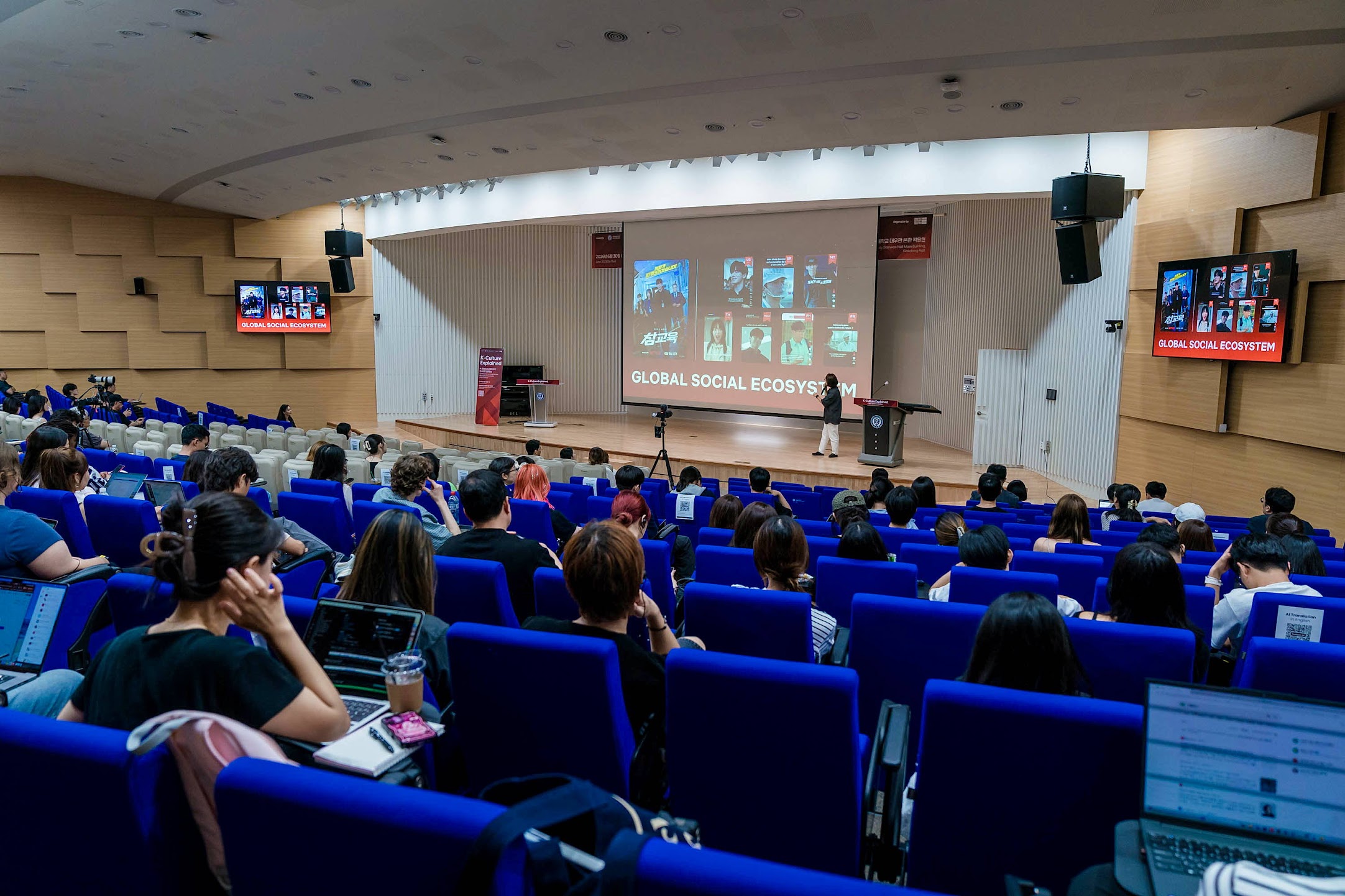
Gakdang Hall filled with the audience; the talks were delivered from the main stage.
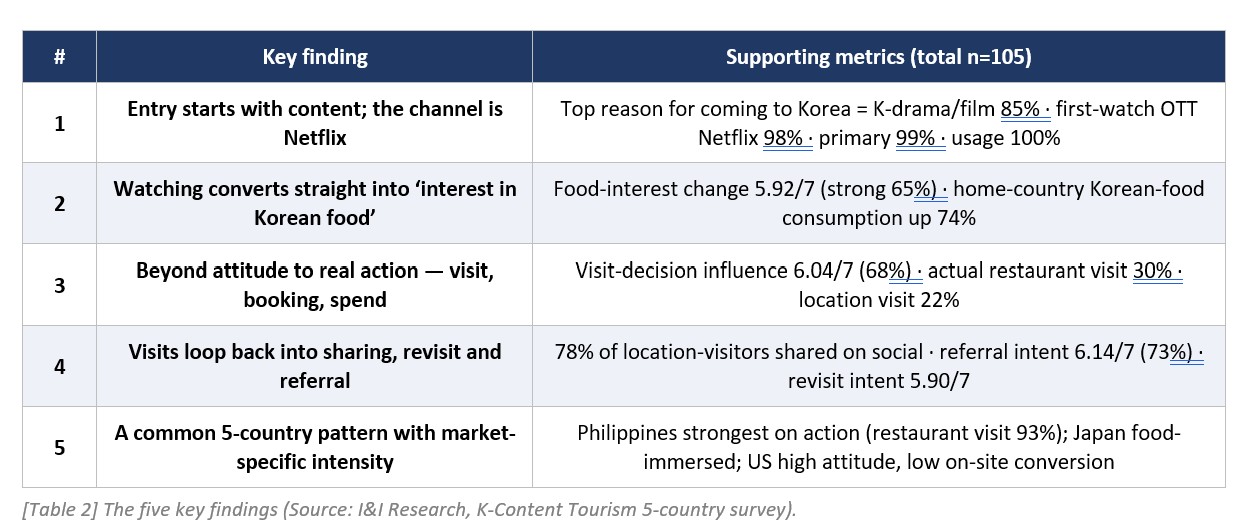
K-Content Tourism 5-country survey
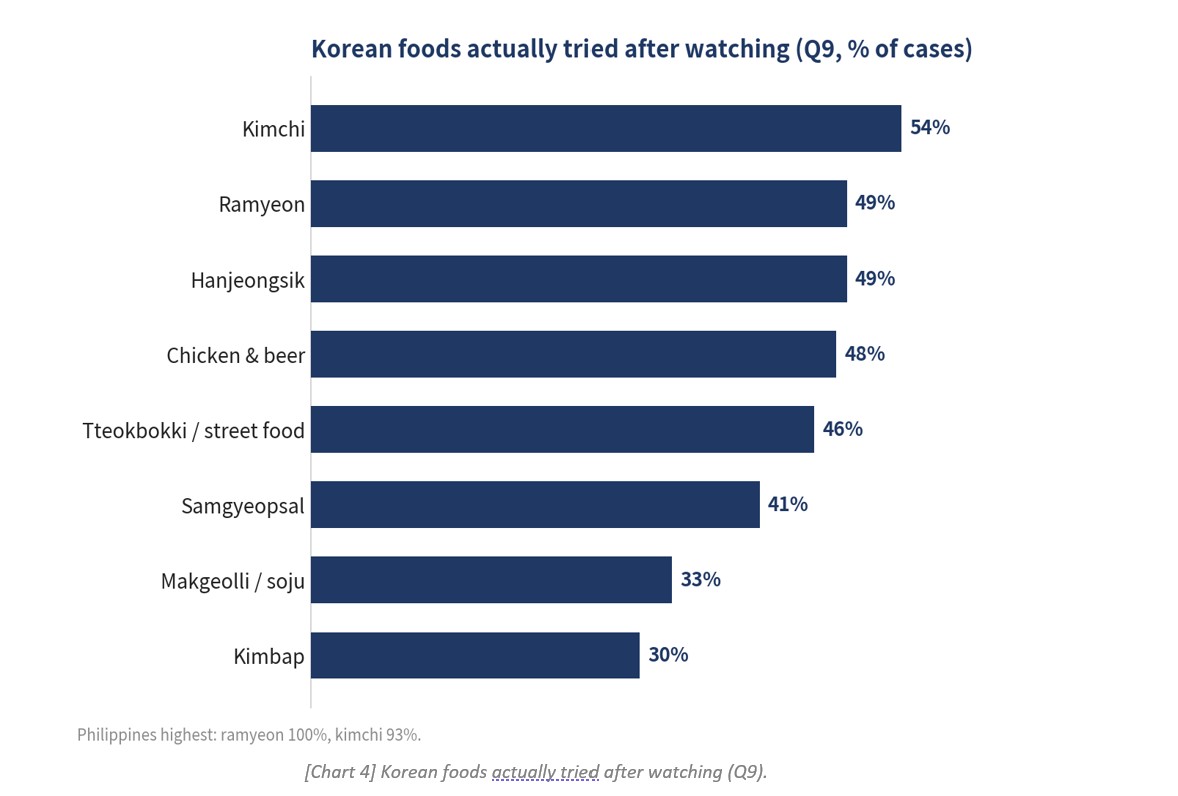
Korean foods actually tried after watching(Survey)
Yonsei University and K-EnterTechHub unveil a 5-country survey and filming-location map showing how OTT viewing converts into real trips to Korea.
SEOUL, SOUTH KOREA, July 6, 2026 /EINPresswire.com/ -- Yonsei University & K-EnterTech Hub host 'K-Culture Explained;' mapping the OTT-tourism path that turns viewers into visitors(July 1, 2026) 'OTT tourism' — viewers of K-content moving through search and flight booking to visit Korea and spend on the ground — has become a constant of Korean tourism. With inbound arrivals hitting a record 18.94 million in 2025 (108.2% of 2019) and a record first quarter of 4.76 million in 2026, exposure now converts directly into travel demand. K-content viewers' intent to visit Korea stands at 72%, double that of non-viewers (37%), with a 0.82 correlation between per-capita viewing time and visit intent across countries.
'K-Culture Explained,' co-hosted by Yonsei University's School of Communication, Office of International Affairs and Communication Research Institute with K-EnterTechHub, was held June 30 at Gakdang Hall, drawing about 300 Korean and international students at the opening of Yonsei's International Summer School. Speakers spanned academia (Profs. Woo Mi-sung, Sang Yoon-mo, Seung-Hoon Jeong), industry (Netflix Korea's Kim Mi-hoo and Lee Kang-i), and the public sector (KTO's Cha Hyuk-jin, Digital Future Institute's Kwon Oh-sang), moderated around Jung HanCEO of K-EnterTechHub. Hudson AI, a leading Korean EnterTech and AI-dubbing company, delivered real-time Korean-English subtitle translation throughout.
"From Viewers to Visitors": seven stages, two bottlenecks
Jung Han presented a seven-stage conversion model — exposure, interest, search, booking, visit, spending, revisit. Per 100 viewers, 85 search and 72 form an intent to visit, but the number nearly halves to 38 at booking, then falls through visit (31) and spending (26) to just 11 long-term repeat visitors. Targeting the intent→booking and visit→revisit bottlenecks, he proposed a multilingual 'One-Stop K-Tourism Pass' and permanent 'content trails,' sustained by an 'OTT Tourism Industry Ecosystem' of seven public-private stakeholders — studios, streamers, tourism bodies, airlines/OTAs, F&B/retail, local governments and ministries — bound around content. Citing Squid Game season 3's 'Young-hee' statue at Gwanghwamun as the shift from 'following after airing' to 'designing before airing' ('OTT Tourism 2.0'), and benchmarks from New Zealand, the UK, Thailand and Iceland, he urged unifying K-content with 'Visit Korea,' standardizing pre-release collaboration and raising incentives to global levels. "The screen is not the end but the start of the journey," Han said.
"From Discovery to Fandom": Netflix's marketing and product strategy
Kim Mi-hoo, Director of Netflix Korea Marketing, defined marketing as creating 'conversation': word of mouth beats any advertisement, and marketing opens the space for fans to take part and spread the story — as in the 'When Life Gives You Tangerines' campaign running from pre-release wedding-photo events to post-launch fan events. "A bigger fandom solves almost every problem," and with simultaneous global launches, "fandom has no time zones and no borders." Netflix's roughly 1.4 billion social followers and 224 billion organic impressions form a "global super-highway" for K-content, from the 'carrot' meme of 'Culinary Class Wars' S2 to fan-made clips on TikTok.
Lee Kang-i, Director of Netflix Korea Product, noted that over 80% of Netflix members worldwide watch Korean content, driven by content creativity, marketing and personalized recommendation — "delivering the right title to this particular person right now." He cited subtitles and dubbing that lower language barriers, personalized visuals (a tense Paik Jong-won image at home vs. food-forward images abroad for 'Culinary Class Wars'), cross-genre taste discovery, a 'Book Adaptations' curation and a mobile vertical discovery feed coming to Korea.
Content moves bookings
'KPop Demon Hunters' lifted flight bookings to Korea by 146% in Spain and 122% in Germany within four weeks, making Bukchon (+118% foreign visits), Myeongdong and N Seoul Tower fandom fixtures. 'Culinary Class Wars' raised featured chefs' reservations 148% within a week, with the foreign-booking share at 38% six months on. 'When Life Gives You Tangerines' generated an estimated 90 billion KRW effect on Jeju, mobilizing 600 crew and 4,000 partner firms. Netflix's 'Netflix Effect' report shows $135 billion invested since 2016 adding over $325 billion to the global economy, with 4,500+ filming locations in 50+ countries and 425,000+ jobs.
Public sector, fandom and 'smart content'
Kwon Oh-sang (Digital Future Institute) argued the public sector must secure 'intermediate data' tracking the path from viewing to revisit by title, country and region — running the entire K-content library as a tourism asset and building a repeatable operating system in which the gains of content diffusion return to Korea's production ecosystem. Cha Hyuk-jin (KTO) framed the Netflix partnership as 'creating real inbound demand': campaigns lifted Korea-related search, awareness and preference together, and the KTO is routing locations into courses, signing drama agreements that reflect tourism from pre-production, and building nationwide landmark installations. Prof. Sang Yoon-mo analyzed viewers' 'flow' and 'narrative transportation' — hallyu contact is the top trigger (39.6%) for interest in visiting Korea — as fandom evolves into a global community of healing and solidarity. Prof. Seung-Hoon Jeong traced how Netflix absorbed cinema's values ('Netflixization': long takes, intensified continuity, mind-game devices, unflinching social critique), with 'KPop Demon Hunters' reaching theaters on the back of online popularity.
First release: the five-country survey and the K-Screen Tour Map
The I&I Research survey of 105 respondents across five countries showed 98% first watched K-content on Netflix, visit-decision influence of 6.04/7, and 78% of location visitors sharing on social media. The interactive 'K-Screen Tour Map (Watch It, Walk It)' launched with 33 coordinates, planned to grow into a continually updated multilingual platform.
Roundtable: "In the streaming era, the content capital is Seoul"
Han declared, "Just as the content capital of the theatrical era was Hollywood, the content capital of the streaming era is Seoul," Kwon stressed designing 'honest data' from the user's side and building an industrial base that lasts 30 years beyond any single hit — within a collaborative ecosystem where creators receive sustainable capital and platforms grow together. Cha said the KTO connects Netflix's global exposure to real visit experiences, spreading demand beyond the capital area through regional-airport entry, stay-type products and location-based courses. Prof. Jeong added that even critically toned K-content draws viewers into a global-citizen sensibility, turning an entertainment platform into a public sphere.
Jung Han
kentertechhub
+1 812-837-7424
email us here
Visit us on social media:
LinkedIn
Facebook
YouTube
Legal Disclaimer:
EIN Presswire provides this news content "as is" without warranty of any kind. We do not accept any responsibility or liability for the accuracy, content, images, videos, licenses, completeness, legality, or reliability of the information contained in this article. If you have any complaints or copyright issues related to this article, kindly contact the author above.
